Any anime series, even the members of the original shonen “big three,” might struggle to stick the landing. Before Jujutsu Kaisen and My Hero Academia let fans down with their rushed or awkward conclusions, Masashi Kishimoto’s Naruto stumbled its way to the finish line in a finale that remarkably few fans enjoyed. Until then, the overall Naruto franchise enjoyed enormous momentum and popularity, and all the pieces were in place for the greatest shonen anime ending of all time. But that’s not what viewers ended up getting.
The lengthy Naruto: Shippuden anime made a lot of promises with its characters and plot, but unfortunately, the anime fumbled some of those promises and replaced some of them with things fans didn’t even ask for. It’s easy to remember the ending of Naruto being bad because the Fourth Great Shinobi War was a protracted slog of endless Dragon Ball-esque fights, but there’s still more to it. A few of the specific character arcs and weird plot twists show how miserable the ending of this otherwise fantastic franchise really was.
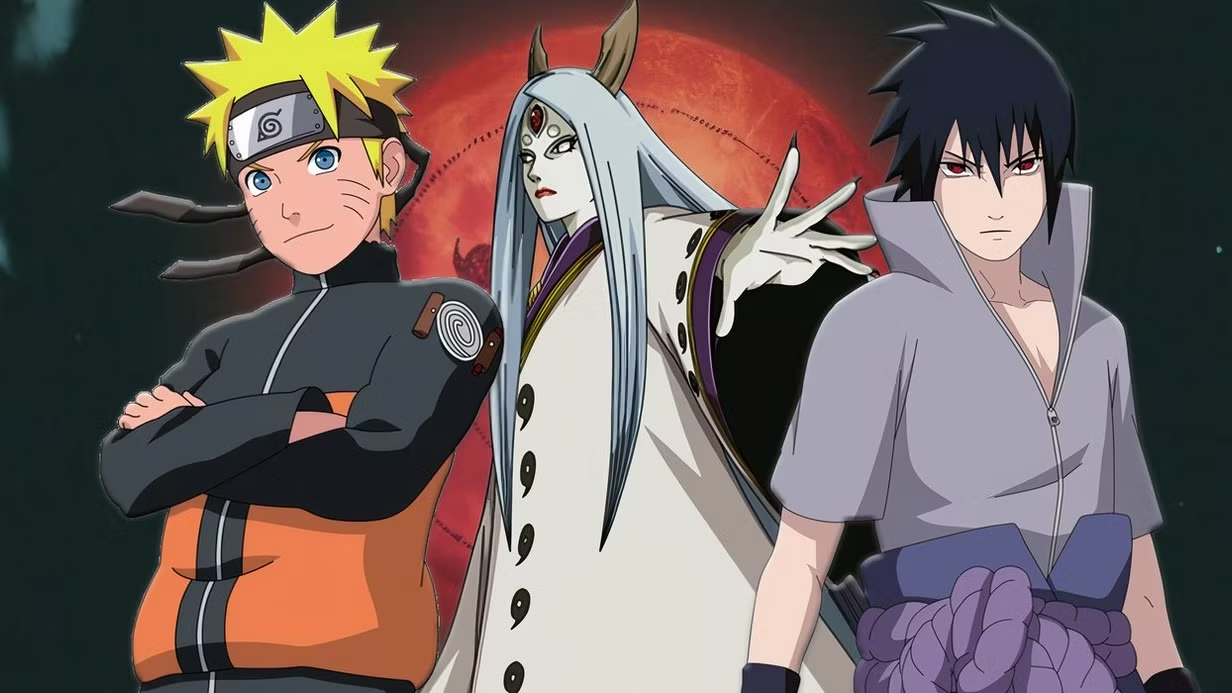
Kaguya Otsutsuki’s Debut Ruined Naruto: Shippuden’s Story
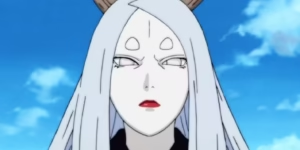
The story of Naruto didn’t always have a strong focus on its villains, certainly not in the anime’s finale. Some arcs, such as the famed Pain Arc in Shippuden, shone because they were clearly centered around a well-defined foe. After Pain’s downfall, Naruto: Shippuden started playing fast and loose with the rules of villainy. Tobi arose as the false Madara Uchiha around the time Kabuto Yakushi returned stronger than ever, and then Obito was redeemed as the real Madara Uchiha rose to power. It seemed that at last, Naruto: Shippuden had settled on its true endgame foe with Madara, and fans were hyped to see Naruto’s heroes fight Madara to the bitter end. Madara’s presence held the entire Fourth Great Shinobi War together, but not even that villainous narrative could remain cohesive for much longer.
To fans’ shock and immense disappointment, Black Zetsu betrayed Madara in favor of Kaguya Otsutsuki, and that marked a turning point for the worse in the anime. It was one example too many of “the villain behind the villain,” a narrative trick that was played out and going in circles. Plot twists like that work best in small doses, such as Tobi falsely claiming to be Madara before the real Madara could arrive. Kaguya’s surprise reveal was one too many, and worse yet, there was hardly any buildup.
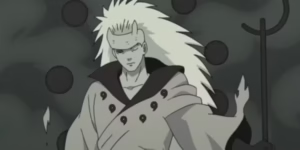
For contrast, at least the name Madara Uchiha was in fans’ minds when Obito revealed his true nature and the real Madara arrived. And of course, the concept of an Uchiha supervillain was well-established thanks to the likes of Sasuke, Itachi, and Obito himself. They felt like “normal” villains who had a clearly defined place in the lore and combat system, but Kaguya enjoyed no such advantages.
Kaguya Otsutsuki truly came out of the blue, a last-minute contrivance that disoriented the characters and viewers alike. Kaguya’s presence and even her very nature felt like an intrusion, as though she were hijacking the flow of events out of selfish interests. Suddenly, space aliens were a core element of Naruto’s worldbuilding, which felt outlandish even in a world of tailed beasts, chakra, and immortality. Put another way, Kaguya and her entire clan felt weird, and while Naruto may be a creative shonen anime with plenty of surprises, this kind of creative twist felt unwelcome. The narrative was grounded in the Fourth Great Shinobi War and matters of various nations or ninja clans. Then, awkwardly enough, Naruto became a space fantasy story about aliens and their chakra fruit.
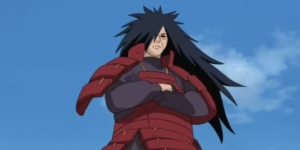
On top of all that, what should have been Naruto: Shippuden’s best villain paid a stiff price for all this. Madara Uchiha was a worthy successor to the likes of Orochimaru and Pain as a fearsome ninja with big dreams and bigger jutsu, and he felt even cooler after Obito’s deceit about who Madara even was. Just when Madara reached the apex of his powers as the Ten-Tails jinchuriki, Black Zetsu made his move, ending Madara’s narrative in Kaguya’s favor.
Suddenly, the villain whom Naruto: Shippuden fans cared so much about in the thrilling endgame was tossed aside, a terrible fate for even the nastiest villains. That’s not because fans felt sorry for the monstrous Madara, but because narratively speaking, villains are supposed to have a cooler ending than that. Madara didn’t deserve a happy ending, but he did deserve an epic one, and Kaguya made sure he didn’t get it.
Naruto Failed to Give Its Supporting Cast the Character Arcs They Deserved
The supervillains suffered from some questionable writing decisions in the botched ending of Naruto: Shippuden, and the supporting cast suffered as well. Several beloved side characters had their arcs either cut short or just taper off, and that felt like a disservice to the characters whom viewers enjoyed watching for so many years. One example is Rock Lee, the martial artist who stunned fans in his fights against Gaara and Kimimaro, only for him to be sidelined in Naruto: Shippuden. His mentor, Might Guy, did get a chance to fight powerful jutsu with the simple strength of taijutsu, but critically, Rock Lee didn’t get his own turn. Might Guy may have been stronger, but Rock Lee was more sympathetic and memorable, meaning it should have been he who took on the villains’ strongest forms in the endgame fight.
Then there’s the matter of Sakura Haruno, who kept lagging behind Naruto and Sasuke even after all her remarkable gains as a kunoichi. Sakura’s glow up felt incomplete, however, since she lacked anything to rival Naruto’s biju cloak or Sasuke’s Susano’o, and Sakura’s personal narrative struggled, too. For the worst and final time, Sakura felt petty and unlikable as a friend and potential love interest to the rest of Team 7. Fans decried Sakura’s emotional manipulation of Naruto Uzumaki from earlier, and she didn’t do nearly enough to make up for it.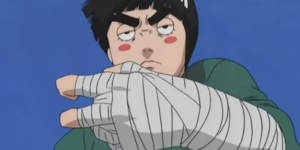
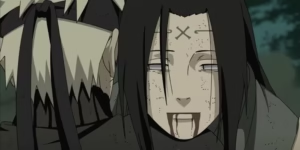
And of course, when Sakura ended up with Sasuke as a canon pairing, it felt uncomfortable in light of Sasuke’s constant abuse of Sakura. For all her progress, Sakura was still a lovestruck fool who would overlook or forgive anything if it meant getting Sasuke’s attention. Neji Hyuga, meanwhile, had one of the most disappointing and anticlimactic deaths in all anime during Naruto: Shippuden’s endgame phase.
On a side note, the character pairings didn’t always deliver. The Sakura and Sasuke pairing felt deeply unhealthy, even if it also felt inevitable, and at the time, the Ino and Sai pairing felt weak as well. Later projects, such as Boruto: Naruto Next Generation,s helped turn Ino’s and Sai’s pairing into something genuinely strong, but it’s a shame the original Naruto anime needed so much help from those later projects to fill that gap. 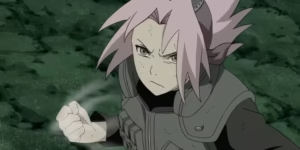 The bright side is how Naruto and Hinata Hyuga got their happily ever after, but even then, the anime didn’t do quite enough to build that up. There were no major obstacles to the Naruto and Hinata pairing, but also not enough momentum to make it feel truly powerful.
Naruto’s Journey Was Undercut By Becoming the Child of Destiny
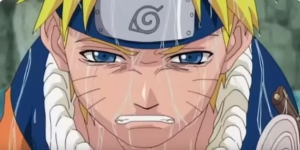
Worst of all, the ending of Naruto: Shippuden did a disservice not just to its villains and its support cast, but also to the hero himself. Naruto was introduced as a tough underdog who fights for everything he’s got, which was what made his lofty dream and his tangible progress so exciting. Naruto started his journey by clawing his way up from the bottom, as many shonen leads do, but the story of Naruto started undercutting all that. First, Naruto’s status as a jinchuriki felt like a cheat code as Naruto kept tapping into Kurama’s vast power to see him through fights he couldn’t win on his own. Naruto was supposed to be the boy born with nothing, but he was actually born with a vast gift waiting to be tamed, and then the endgame of Naruto: Shippuden compounded all this.
It was already questionable to present Naruto as a self-made underdog hero when he had Kurama’s chakra backing him up, and then the underdog image was shattered entirely with a certain late-game revelation. It was revealed how Naruto was the inheritor of Asura’s will and chakra, while his rival Sasuke was the successor of Asura’s villainous brother Indra. Naruto was thus a child of destiny, having the right pedigree to be the one to end the Fourth Great Shinobi War. Fate itself dictated the course of Naruto’s life, putting him on a collision course with Sasuke as the two of them fought as proxies for the rival brothers Asura and Indra.
Continue reading>>