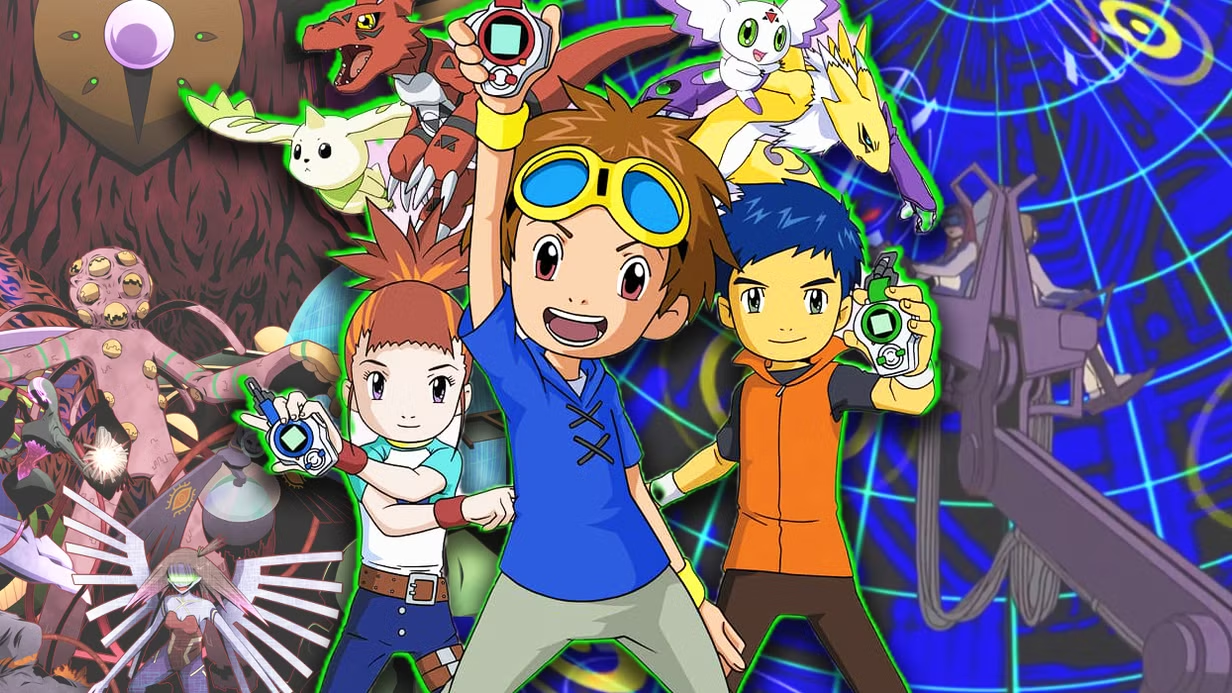
Unlike other franchises of its kind, Digimon has boldly experimented with all its iterations. Digimon Adventure 02 officially marked the end of a continued timeline as the third season paved the way for a completely different era. Digimon Tamers introduced a new set of DigiDestined and an entirely new Digital World. The anime’s inception was a defining moment in the franchise, but it also divided the fandom.
Some Digimon fans found the change of pace and scenery welcoming, while others thought that the new story did not adjust well in the overall canvas. However, disliking Digimon Tamers out of loyalty to the original series did not change the fact that it was actually good. The upending of the original lore and discontinuity that came with this particular season made it a success.
Nostalgia Might Have Been Digimon Tamers’ Biggest Enemy
Nostalgia can be unforgiving, and iconic franchises often face the harshest criticism from fans when they attempt to evolve over time. The first Digimon Adventure series was a groundbreaking entry in the isekai genre. It subverted the existing tropes and introduced refreshing elements that were considered revolutionary at the time. That’s why the franchise tried to channel the same energy by promising fans continuity with a twist. Digimon Adventure 02 was the official sequel to Digimon Adventure, featuring both new and returning DigiDestined. Unfortunately, the audience’s reception wasn’t as overwhelming as it was for the original series, which cast doubt on whether connectivity was a smart move.
Introducing older DigiDestined invoked nostalgia, but how long would that have worked, especially with Tai and co. not being the main characters? Then came Digimon Tamers with the promise of new characters and a different world with fresh foundations. The fans’ initial impression of a “new dawn” was obviously shrouded in disapproval only because it was a huge shift from the original premise. However, as the story progressed, the viewers realized that maybe change wasn’t that bad after all. Digimon Tamers offered brand new concepts, including how the human and digimon partners come together.
Although the series’ explanation about how exactly the digimons came to be in the human world is ambiguous, it’s heavily implied that it was because of a card game. Moreover, the absence of the Digital World backdrop meant that the story could expand in multiple directions. Fans eventually realized that while they wanted another Digimon Adventure, a new story and characters weren’t a bad bet. It could have been an opportunity for a shared universe, and while that didn’t happen, Digimon Tamers did live up to the fundamental elements that made fans fall in love with the franchise in the first place.
The Transition To the New DigiDestined After 02 Was Necessary

It’s safe to say that the Digimon franchise struggled with continuity. The fans felt that the sequel should have been inherently about the original DigiDestined as they grew up, rather than being in the backseat. The idea was eventually executed in Digimon Adventure tri. but the hype had died down by then. Therefore, the best way to tackle the fandom’s disappointment was to start fresh. While Takato, Henry, and Rika were no Taichi and Yamato, they were intriguing characters in their own right. One of the most prevailing qualities of Digimon Tamers, in contrast to its predecessor, was that it didn’t feature one-dimensional character arcs.
It could also be that fewer DigiDestined meant that the plot had space to accommodate their growth rather than focusing on the central “goggle” character. They did not fall victim to stereotyping, especially Rika, since even a franchise as thriving as Digimon has cut corners when it came to developing strong female characters. Rika stood as strong as Takato and Henry, especially in battle. Understandably, series like Digimon have certain slots for characters, and they rarely develop outside those boundaries. For instance, Taichi and Yamato, being the central characters, naturally had more screen time and opportunities to attain higher digivolution forms. After them are the “mid-characters,” such as Izzy, Sora, Hikari, and T.K., who are awarded important arcs from time to time.
Finally, there are tail-enders like Mimi and Joe, who are the group’s passive members, people who prefer to stay out of the line of fire. However, Digimon Tamers broke the mold by empowering all of its characters and offering them somewhat similar chances to experience higher evolution. The distribution of importance among Takato, Rika, and Henry is balanced, resulting in a consistent level of digivolutions across the board. Fans appreciated how the series embraced originality rather than adhering to a predictable formula.
Digimon Tamers’ Darker Plotline Made It More Appealing

The Digimon franchise has consistently been exceptional thematically, regardless of the success of each season. The original series had a profound impact on viewers with its thought-provoking and emotionally charged themes. Having said that, one can’t deny the impressive tonal shift in Digimon Tamers. The series shares Digimon Adventure’s innocence, adventure-style narrative, and young protagonists, but it becomes particularly dark when it chooses to. The character arcs are inherently poignant as they deal with the children’s deepest and darkest fears. For instance, Takato is a textbook anime protagonist who is brave, overly zealous, and persistent in the face of adversity.
Digimon Tamers’ take on digital warfare, government conspiracies, and formidable villains made it more unnerving than the original series.
However, Digimon Tamers also explores the possibility of him being negatively affected by the burden of always being the one with the solutions. Takato believed he was supposed to rise above and win the battle, but when he faced defeat, it took a toll on him. Similarly, the series also has a profound take on loss and grief that is maturely handled compared to its predecessors. For instance, Jeri’s arc was one of the most devastating and darkest subplots in the series. The show fearlessly delved into the heart-wrenching aftermath of losing someone close.
While many viewers applauded Digimon Tamers’ bold exploration of mature themes, some fans felt the somber tone was too depressive and gloomy by Digimon’s standards. It’s understandable that Digimon isn’t innately dark, but when one is dealing with vicious villains and the fate of the world hanging in the balance, things can always go sideways. Therefore, the viewers may have initially found Digimon Tamers’ bleakness a little unsettling, but it’s justified. The characters are mature for their age and are more accepting of their circumstances, as opposed to being dismissive about their destinies.
Read more>>